Baker's Percentage Explained: The Math Every Sourdough Baker Needs
Quick Answer
Baker's percentage makes every sourdough recipe scalable and comparable. Learn how it works, how to read any recipe in it, and how to write your own.
Every professional baker writes recipes in baker's percentages. Once you understand the system, you can read any formula in the world, scale it to any size, and instantly understand how a recipe will behave, without baking it first.
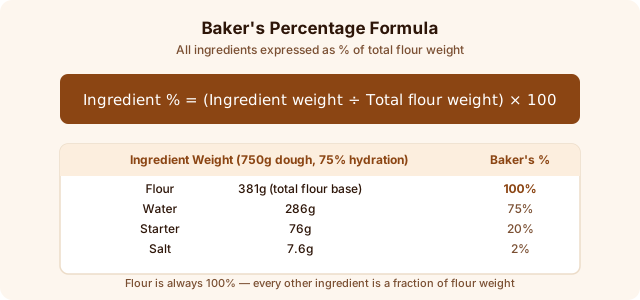
If you've been using recipes that say "500g flour, 350g water, 100g starter, 10g salt" without understanding the underlying ratios, this is the post that changes how you think about bread.
The Core Rule: Flour Is Always 100%
Baker's percentage is different from normal percentage. In normal math, percentages are proportions of the total. In baker's math, percentages are proportions of the total flour weight, and flour is always 100%, even though it's not 100% of the dough.
This one rule unlocks everything. Here's why it matters: if you change the flour weight (to scale the recipe), every other ingredient's gram weight changes proportionally. The percentages stay the same. The recipe is always correct regardless of batch size.
Standard formula:
- Flour: 100%
- Water: 70% (for 70% hydration)
- Starter: 20%
- Salt: 2%
With 500g flour: Water = 350g, Starter = 100g, Salt = 10g. Total dough = 960g.
With 750g flour: Water = 525g, Starter = 150g, Salt = 15g. Total dough = 1,440g.
The percentages never change. Only the grams change. That's the power of the system.
How to Read a Baker's Percentage Formula
Say you find a recipe that reads: "72% hydration, 20% starter, 2.2% salt." You want to bake a 900g loaf.
Step 1: Add all percentages together: 100 + 72 + 20 + 2.2 = 194.2%
Step 2: Your target dough weight divided by that total gives you the flour weight: 900 ÷ 1.942 = 463g flour (round to 465g for convenience)
Step 3: Calculate each ingredient:
- Water: 465g × 0.72 = 335g
- Starter: 465g × 0.20 = 93g
- Salt: 465g × 0.022 = 10g
- Total: 465 + 335 + 93 + 10 = 903g
You're within 3g of your target. Close enough.
The sourdough calculator does this math automatically, input your target dough weight and percentages and it outputs exact grams. But knowing the manual method means you can verify any tool's output and adapt on the fly.
Why Baker's Percentage, Not Regular Percentage?
A recipe could be written as percentages of total dough weight instead. But then every percentage would shift every time you adjusted any one ingredient. If you added 5% more water, every other percentage would change, including flour.
Baker's math avoids that problem by anchoring everything to flour. Flour is stable. It doesn't change unless you're explicitly rescaling the recipe. Water, starter, and salt all float relative to flour, which makes adjustments simple and isolated.
Practical example: You want to reduce hydration in an existing recipe from 75% to 70%. With baker's percentages, you just subtract 5% from the water calculation. With regular percentages, you'd have to recalculate everything from scratch.
Worked Example: Calculating From Scratch
Let's build a 1,000g dough from a formula you design.
You decide: 74% hydration, 18% starter, 2% salt.
Total percentage: 100 + 74 + 18 + 2 = 194%
Flour weight: 1,000 ÷ 1.94 = 515g (round to 515g)
Ingredient weights:
- Flour: 515g
- Water: 515g × 0.74 = 381g
- Starter: 515g × 0.18 = 93g
- Salt: 515g × 0.02 = 10g
- Total: 999g ✓
This is exactly how professional bakers design new formulas. Start with flour at 100%, decide your ratios based on what you want the bread to do, then calculate grams.
Accounting for Starter Hydration
Your starter isn't pure flour or pure water, it's a mixture of both. This means it contributes to both your flour total and your water total in the final dough.
For a starter maintained at 100% hydration (equal parts flour and water by weight): 100g of starter = 50g flour + 50g water.
If you're being precise (which you should be for recipes above 75% hydration), adjust your formula:
Example: Recipe calls for 500g flour (before accounting for starter), 75% water, 20% starter (100g), 2% salt.
- Starter flour contribution: 50g
- Starter water contribution: 50g
- True flour total: 500g + 50g = 550g
- True water total: 275g + 50g = 325g (but you only add 275g of water to the bowl, since 50g comes from starter)
- True hydration: 325 ÷ 550 = 59%... wait, that's not 75%
This is the common confusion. When the recipe says "75% hydration," it usually means 75% based on the flour weight excluding the flour in the starter. Some bakers calculate inclusive of starter flour; some don't. The sourdough calculator accounts for starter hydration explicitly so you get accurate numbers either way.
Multi-Flour Recipes
Many sourdough recipes blend flours, typically 80–90% white bread flour with 10–20% whole wheat or rye.
Baker's percentage still works the same. Just track total flour weight, then note the blend separately.
Example:
- 450g bread flour (90%)
- 50g whole wheat flour (10%)
- Total flour: 500g (100%)
- Water: 375g (75%)
- Starter: 100g (20%)
- Salt: 10g (2%)
The individual flour percentages (90% bread flour + 10% whole wheat) add up to 100% of total flour. Easy.
Converting Existing Recipes to Baker's Percentages
Find a recipe that gives gram weights. Divide every ingredient's weight by the total flour weight and multiply by 100.
Example recipe: 400g flour, 300g water, 80g starter, 8g salt.
- Flour: 400 ÷ 400 × 100 = 100%
- Water: 300 ÷ 400 × 100 = 75%
- Starter: 80 ÷ 400 × 100 = 20%
- Salt: 8 ÷ 400 × 100 = 2%
Formula: 75% hydration, 20% starter, 2% salt. Now you can scale this to any dough weight and compare it to any other recipe at a glance.
Baker's Percentage and Hydration
Hydration is just the water percentage in baker's math. This is why the sourdough hydration guide talks in percentages rather than grams, a 75% hydration recipe scales to any batch size without recalculating.
When comparing recipes, you can look at the percentages and immediately know:
- Is this a wet dough or a stiff dough? (hydration)
- Is this a sour or mild recipe? (starter percentage and fermentation time)
- Will this be well-seasoned? (salt percentage, should be 1.8–2.2%)
A recipe with 20% starter ferments faster than one with 12% starter at the same temperature. Higher starter percentage = more microbial activity = faster bulk fermentation.
The Salt Rule
Salt should be 1.8–2.2% of flour weight for most sourdoughs. Below 1.8% and the bread tastes flat. Above 2.2% and fermentation slows noticeably (salt inhibits microbial activity at high concentrations).
2% is the standard. For a 500g flour loaf: 10g salt. Weigh it, don't measure by teaspoon. Salt density varies by brand and grind.
What You Can Read From Percentages Alone
Once you're fluent in baker's percentages, you can look at a formula and predict its behavior:
| Percentage | What It Means |
|---|---|
| Hydration 60–68% | Stiff dough, tight crumb, easy to handle |
| Hydration 70–76% | Standard sourdough, medium-open crumb |
| Hydration 78–85% | Wet dough, open crumb, requires technique |
| Starter 15–18% | Slower fermentation, milder flavor |
| Starter 20–25% | Faster bulk, more active rise |
| Starter 30%+ | Very fast bulk, use with care in warm weather |
| Salt 1.8–2% | Standard seasoning |
| Salt below 1.5% | Under-seasoned, may taste bland |
This is the fluency that separates bakers who understand their bread from bakers who just follow instructions. Once you see recipes as ratios rather than gram lists, you can adapt, scale, and design without a calculator in your hand, though the run the numbers for your loaf tool is still useful for the actual gram weights.
Further reading:
- Sourdough Hydration Guide, how to pick the right water percentage for your flour and goal
- How to Scale Sourdough Recipes, applying baker's percentages to double, halve, or batch your bake
- Learn more about the Sourdough Calculator Team and how this site was built