How to Scale Sourdough Recipes Up or Down Without Ruining Them
Quick Answer
Scale sourdough recipes to any dough weight using baker's percentages. Learn what changes when you double a batch and what stays exactly the same.
Doubling a sourdough recipe sounds simple, just multiply everything by two. And mostly, that's right. But there are a few things that change when you scale, and if you don't know what they are, you'll end up with either an under-fermented giant loaf or an over-proofed single roll.
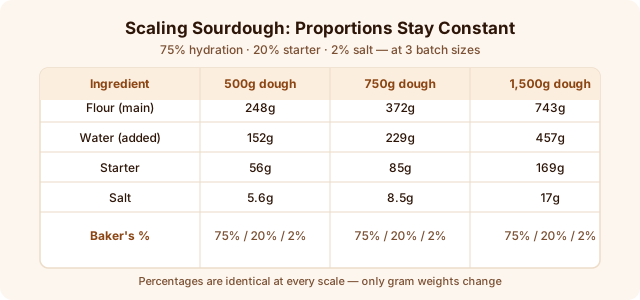
This guide covers the math, the exceptions, and the practical adjustments for scaling sourdough up or down with confidence.
The Math Is Simple (Thanks to Baker's Percentages)
Sourdough recipes written in baker's percentages scale perfectly. The percentages don't change, only the gram weights do.
Standard single-loaf formula:
- Flour: 500g (100%)
- Water: 375g (75%)
- Starter: 100g (20%)
- Salt: 10g (2%)
- Total: 985g → yields roughly 900g baked loaf (water evaporates during baking)
Scaling to two loaves (double batch):
- Flour: 1,000g
- Water: 750g
- Starter: 200g
- Salt: 20g
- Total: 1,970g
Every ingredient doubles. Percentages stay identical. The sourdough calculator does this calculation from your target total dough weight, input 1,970g (or whatever your two-loaf target is) and it outputs the exact grams.
Scaling Down: The Mini Loaf or Test Bake
Want to test a new recipe before committing to a full batch? Scale down to 50%.
Half-batch from the same formula:
- Flour: 250g
- Water: 188g
- Starter: 50g
- Salt: 5g
- Total: 493g → roughly 450g baked loaf
This fits in a small Dutch oven (2–3 qt capacity). Perfect for testing hydration or flour combinations before baking a full loaf.
Practical tip for small batches: Below 300g flour, fermentation and heat dynamics change noticeably. Small doughs cool down faster in the fridge and can overproof on the counter more quickly. Watch timing, not the clock.
The Variables That Stay Constant
- Baker's percentages, always the same
- Fermentation temperature, same environment, same rate (mostly)
- Scoring technique, same approach
- Baking temperature, 500°F (260°C) preheat, same Dutch oven procedure
- Shaping technique, same tension, same method
What Actually Shifts at Larger Batch Sizes
1. Bulk Fermentation Time
A larger mass of dough retains heat better. The center of a 2kg dough bulk-fermenting in a covered container will be warmer than a 1kg dough in the same kitchen. Warmer = faster fermentation.
Practically, a doubled batch may bulk-ferment 15–30 minutes faster than a single loaf in the same conditions. Not a huge difference, but worth knowing. Look for the same signs of completion, 50–75% volume increase, domed surface, jiggly texture, rather than watching the clock.
2. Mixing Effort
More dough takes more work. If you're hand-mixing, a double batch with 1,000g flour is genuinely tiring during the stretch-and-fold phase. Consider doing the first mix in two bowls and combining after autolyse.
With a stand mixer, most home mixers max out around 1,200–1,500g flour before straining. Check your machine's capacity.
3. Dutch Oven Fit
Most home Dutch ovens (4–7 qt / 3.8–6.6L) fit a single loaf comfortably. A double batch means two loaves, you need two Dutch ovens, or you bake sequentially. The second loaf can cold-proof in the fridge while the first bakes.
If you're making multiple loaves, shape all of them and cold-proof overnight. Bake first thing in the morning, one after another, starting with a cold Dutch oven for each. (Cold Dutch ovens are fine, the oven preheats them during the first bake anyway.)
4. Salt Dissolving
This sounds minor but matters at scale. 20g salt in 750g water dissolves faster than 20g in 375g water. At large scale (5+ loaves), some bakers pre-dissolve salt in a small amount of warm water before adding to the dough, just to ensure even distribution.
Scaling for a Specific Loaf Weight
Sometimes you want to start from the target baked loaf weight and work backwards. A typical sourdough loses about 10–15% of its raw weight during baking (water evaporates). So a 900g baked loaf started as roughly 1,000–1,050g of raw dough.
Target: Two 900g baked loaves
- Raw dough needed: 2 × 1,020g = 2,040g (using 12% bake loss)
- At 194% total (100% flour + 75% water + 18% starter + 2% salt = 195% → round to 195):
- Flour: 2,040 ÷ 1.95 = 1,046g → round to 1,050g
- Water: 1,050g × 0.75 = 788g
- Starter: 1,050g × 0.18 = 189g → round to 190g
- Salt: 1,050g × 0.02 = 21g
Total raw dough: 1,050 + 788 + 190 + 21 = 2,049g. Close enough.
The calculate your dough handles this automatically when you specify your target dough weight.
Scaling for Larger Batches (4–10 Loaves)
Home bakers who freeze loaves or sell at farmers markets sometimes need 4–10 loaves at once.
Worked example: 6 loaves at 900g baked weight each
Target raw dough: 6 × 1,020g = 6,120g
- Flour: 6,120 ÷ 1.95 = 3,138g → round to 3,150g
- Water: 3,150g × 0.75 = 2,363g
- Starter: 3,150g × 0.18 = 567g
- Salt: 3,150g × 0.02 = 63g
At this scale, you'll likely need a commercial mixer or to mix in two batches. You'll also want a large proofing container, a hotel pan or food-safe storage bin works well.
Fermentation time at large scale: Large dough masses retain heat and generate their own heat from fermentation. A 3kg bulk ferment may be 30–45 minutes faster than a 500g batch in the same room. Watch the dough, not the timer.
The One Thing You Should Never Scale: Bake Temperature
Bake temperature is fixed at around 500°F (260°C) with lid on for 20 minutes, then 450°F (232°C) with lid off for 20–25 minutes. This doesn't change with batch size because each loaf bakes separately in its own Dutch oven.
What does scale slightly is bake time for unusually large or dense loaves. A loaf over 1,100g raw weight may need 5 extra minutes lid-off to fully brown. Use a probe thermometer, internal temp of 205–210°F (96–99°C) means it's done.
Scaling Partially: Adjusting One Variable
Sometimes you want to keep the batch the same size but change one thing, say, adding 10% whole wheat to an existing white flour recipe.
This is where baker's percentages shine. Keep flour total at 500g:
- 450g bread flour (90%)
- 50g whole wheat (10%)
- Water: adjust up by ~20g to compensate for whole wheat's higher absorption
- Starter and salt: unchanged
No rescaling of the whole recipe. Just adjust the one variable in percentage terms, then recalculate the gram weight for that ingredient.
Fermentation Adjustments When You Scale Down
Scaling down deserves its own section because most guides only talk about scaling up. When you bake a 250g flour test loaf, a few things change:
Smaller dough loses heat faster. During bulk fermentation, large dough masses retain the heat generated by fermentation itself. A 250g flour batch in a small bowl will cool toward room temperature faster than a 1kg batch. In a cool kitchen (20°C), add 10–15% to your expected bulk time for small batches.
Fridge proofing is more aggressive. A small shaped loaf cools all the way through within 30–45 minutes in the fridge. A large boule may take 2+ hours to reach fridge temperature. This means small loaves stop fermenting sooner, which can be good (less overproofing risk) or frustrating (less flavor development from the cold proof).
Oven spring behaves differently. A 450g raw dough loaf will brown faster in a Dutch oven than a 950g loaf because it's surrounded by more hot air relative to its mass. Reduce the lid-off time by 3–5 minutes and watch the color.
Converting a Recipe to a Different Dough Weight
The cleanest way to scale any recipe to a specific target dough weight:
- Add all baker's percentages together (flour 100% + water % + starter % + salt % = total %)
- Divide target dough weight by that total percentage (as a decimal)
- Result = flour weight
- Multiply flour weight by each other percentage to get ingredient weights
Example: Scale a recipe to exactly 800g dough
Recipe: 75% hydration, 20% starter, 2% salt Total: 100 + 75 + 20 + 2 = 197% = 1.97
Flour: 800 ÷ 1.97 = 406g (round to 405g) Water: 405 × 0.75 = 304g Starter: 405 × 0.20 = 81g Salt: 405 × 0.02 = 8g Total: 405 + 304 + 81 + 8 = 798g (close enough, rounding differences)
The sourdough calculator runs this exact calculation from your target dough weight. Plug in your target and percentages and it outputs grams for every ingredient immediately.
Related reading:
- Baker's Percentage Explained, the math system that makes scaling this simple
- Best Flour for Sourdough, how to adjust hydration when you blend flours at scale
- Sourdough Baking Schedule, how to stagger multiple loaves through a single bake day