The Complete Sourdough Baking Schedule for Beginners
Quick Answer
A sourdough baking schedule makes the 36-hour process manageable. Here's a day-by-day timeline with same-day and cold-proof variations to fit your life.
Sourdough's biggest barrier isn't technique, it's time management. The process spans 24–48 hours and touches multiple parts of your day. Without a clear schedule, you'll either be shaping dough at midnight or baking a loaf that sat in the fridge 20 hours too long.
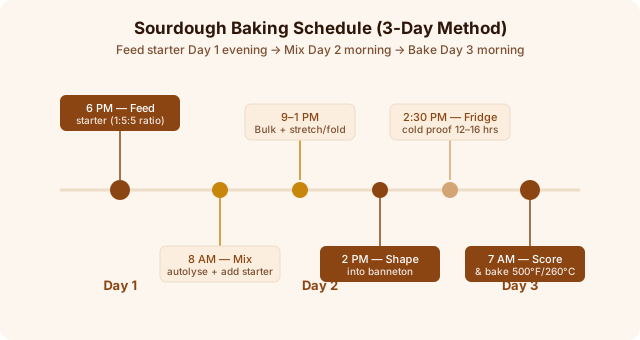
This schedule is built for a standard 900g sourdough boule using 500g bread flour at 75% hydration and 20% starter. Once you understand the rhythm, you can shift every step earlier or later to fit your actual life.
What You Need Before You Start
Before the timeline begins, you need:
- An active starter that has peaked within the last week
- 500g bread flour, 375g water, 100g active starter, 10g salt
- A Dutch oven (5-quart minimum), bench scraper, banneton, lame
- A kitchen scale
Don't estimate quantities. Use the sourdough calculator to calculate exact gram weights for your target loaf size and hydration before you mix anything.
The Standard 2-Day Schedule (Feed Night 1, Bake Morning Day 3)
This is the most reliable schedule for most home bakers. Your active time across both days is about 40–45 minutes total.
Day 1, Evening (5–10 minutes active)
8:00 PM, Feed your starter
Discard all but 20g of your refrigerated starter. Feed with 40g flour + 40g water (1:2:2 ratio). Stir well, cover loosely, and leave at room temperature (ideally 22–24°C / 72–75°F).
This gives your starter 10–12 hours to peak overnight, landing at peak around 6–8 AM Day 2.
If your kitchen is warmer (25°C+), use a 1:3:3 or 1:5:5 ratio so the starter doesn't peak and collapse before morning.
Day 2, Morning (20–25 minutes active)
7:00 AM, Check starter
The starter should have doubled or tripled in volume, have a domed or slightly convex surface, and smell yeasty and mildly sour. If it's already collapsed (concave, liquid on top), it peaked while you slept, still usable if it's been less than 2 hours past peak. If it hasn't risen much, give it 1–2 more hours.
7:30 AM, Mix the dough (autolyse)
Combine 500g flour and 340g water (hold back 35g of your 375g total for later). Mix until no dry flour remains. Cover and rest 30–45 minutes. This autolyse lets gluten develop without starter or salt present, which improves dough extensibility.
8:15 AM, Add starter and salt
Add 100g active starter. Squeeze and fold to incorporate, it takes about 3–4 minutes until fully mixed. Add 10g salt dissolved in the remaining 35g warm water. Mix again for 2 minutes.
This is your total dough: roughly 985g.
8:30 AM – 2:00 PM, Bulk fermentation (5–6 hours at 24°C)
Cover the bowl and let it sit. During the first 2 hours, perform 4 sets of stretch-and-folds:
- 8:45 AM (15 minutes after mixing)
- 9:15 AM (30 minutes later)
- 9:45 AM (30 minutes later)
- 10:15 AM (30 minutes later)
Each set: grab the dough at one side, stretch up and fold to the opposite side. Rotate 90° and repeat 3 more times = 4 folds per set. Takes 30–45 seconds per set.
After the 4 sets, leave the dough undisturbed for the remaining bulk time. It should increase 50–75% in volume, feel airy, and jiggle when you shake the container.
2:00 PM, Pre-shape
Turn the dough onto an unfloured surface. Use a bench scraper to fold the edges toward the center, then flip the dough smooth-side up. Use the bench scraper to drag the dough toward you across the surface, building surface tension. The bottom of the dough should feel taut.
Cover and rest 20–30 minutes (bench rest).
2:30 PM, Final shape and cold proof
Shape into a boule or batard. Place seam-side up in a floured banneton. Cover with plastic wrap or a shower cap.
Refrigerate immediately at 38–40°F (3–4°C). The dough needs 8–16 hours of cold proof.
Day 3, Morning (15–20 minutes active)
6:30 AM, Preheat oven
Place your Dutch oven inside and preheat to 500°F (260°C). Set a timer for 45–60 minutes. The Dutch oven must be fully saturated with heat, not just the air temperature reading.
7:30 AM, Score and bake
Remove the dough from the fridge. Flip onto a piece of parchment paper. Score immediately with a lame at 15–30° from horizontal, one confident stroke the full length of the loaf.
Lift the parchment with the dough into the screaming-hot Dutch oven. Lid on.
- 20 minutes at 500°F, lid on (steam baking, maximum oven spring)
- 20–25 minutes at 450°F, lid off (crust browning and drying)
Internal temperature should reach 205–210°F (96–99°C). If you don't have a probe thermometer, knock the bottom of the loaf, it should sound hollow.
7:55 AM (or whenever done), Cool on a rack
Leave the loaf on a wire rack for at least 1.5–2 hours before cutting. The crumb is still setting. Cutting early compresses the interior and produces a gummy texture even if the bake was perfect.
Total active time: ~40–45 minutes across 2+ days.
Same-Day Bake Option (Start to Oven in 12–15 Hours)
If you want to bake the same day you start, push fermentation faster with a warmer environment and higher starter percentage.
Modified formula: Same flour and water amounts, but use 150g starter (30% instead of 20%) and keep dough at 26–28°C.
Same-day timeline (starting at 7:00 AM):
- 7:00 AM: Feed starter 1:1:1 (if not already active)
- 8:30 AM: Autolyse (30 minutes)
- 9:00 AM: Add starter + salt, begin bulk
- 9:00–1:30 PM: Bulk fermentation (4–4.5 hours at 27°C)
- 1:30 PM: Pre-shape, bench rest 20 minutes
- 1:50 PM: Final shape
- 1:50 PM: Cold proof in freezer for 45–60 minutes (not overnight, just to firm the dough for scoring)
- 3:00 PM: Preheat Dutch oven 45 minutes
- 3:45 PM: Score and bake
- 5:00 PM: Loaf done, cooling on rack
This produces good bread, but the shorter fermentation means less flavor development than the overnight cold proof. Good for when you want sourdough for dinner without planning two days ahead.
Extended Cold Proof (Up to 48 Hours)
After shaping, the dough can cold-proof in the fridge for up to 48 hours. Longer cold proof = more complex, more acidic flavor. Acetic acid (the sharp, vinegary sourdough character) develops more at cold temperatures than lactic acid.
At 40 hours of cold proof, your dough will have noticeably more sourness than at 12 hours. Whether that's better is personal, many bakers prefer 16–20 hours as a flavor balance.
Watch for overproofing: If you see large bubbles forming on the dough surface or the dough feels very airy and doesn't spring back when you poke it, it's at risk of overproofing. Bake it.
Adjusting the Schedule for Your Life
If you work early mornings: Feed starter at 6 PM. Mix dough at 7–8 PM. Bulk ferment overnight at a cool room temperature (18–20°C takes 10–12 hours). Shape at 7 AM. Cold proof during the day. Bake when you get home at 5–6 PM.
If you work late nights: Feed starter at 10 AM. Mix at noon. Bulk ferment through the afternoon. Shape at 6 PM. Cold proof overnight. Bake at 7 AM before work.
Weekends only: Feed starter Friday night. Mix Saturday morning. Cold proof Saturday night. Bake Sunday morning.
The calculate your dough tool handles the formula regardless of which schedule variation you're running. Input your flour weight and target hydration, and it outputs exact grams for every ingredient.
Temperature Reference Table
Knowing your kitchen temperature removes most of the guesswork:
| Dough Temp | Approx. Bulk Time | Notes |
|---|---|---|
| 18–20°C (64–68°F) | 9–12 hours | Very slow, great flavor development |
| 21–23°C (70–73°F) | 7–9 hours | Slightly slow, reliable |
| 24–25°C (75–77°F) | 5–7 hours | Standard timing for most recipes |
| 26–28°C (79–82°F) | 4–5 hours | Fast, watch carefully |
| 29°C+ (84°F+) | 3–4 hours | Very fast, high overproofing risk |
Related reading:
- Sourdough Starter Feeding Ratios, feeding ratio and timing controls when your starter is ready for mixing
- Common Sourdough Mistakes, most timing mistakes happen during bulk fermentation
- How to Scale Sourdough Recipes, once you have the schedule down, scaling up to 2–3 loaves is straightforward
- More on how this site was built and why: About the Sourdough Calculator