7 Common Sourdough Mistakes (and How to Fix Every One)
Quick Answer
Most sourdough mistakes come down to fermentation timing, starter health, or hydration mismatch. Here are 7 common problems with specific fixes for each.
Bad sourdough isn't random. Every dense loaf, gummy crumb, or flat disc that comes out of your oven has a specific cause. The frustrating part is that sourdough gives you delayed feedback, you won't know what went wrong until you cut the loaf 2 hours after baking.
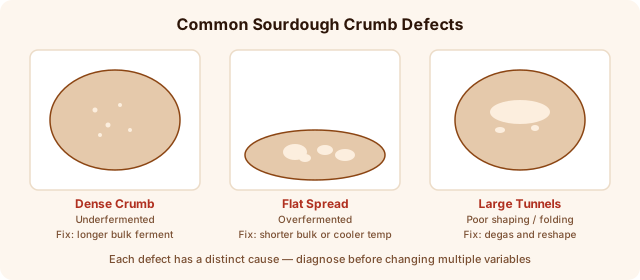
Here are the 7 most common mistakes with diagnosis and specific fixes.
Mistake 1: Underfermented Dough (The Dense Gummy Loaf)
Symptoms: Loaf doesn't rise much in the oven. Crumb is dense, gummy, and tears when you cut it. Large irregular tunnels running through the crumb. Pale, thin crust.
Why it happens: Bulk fermentation ended too early. The gluten network hadn't developed enough strength and the dough didn't have enough gas pockets to support a good rise.
The common triggers:
- Kitchen temperature below 20°C (68°F), fermentation slows dramatically below this point
- Starter not at peak when added to dough, using a starter 2 hours past its peak means depleted yeast activity
- Too short a bulk time, many recipes say "4–6 hours" but that assumes 24–25°C. At 20°C, the same recipe may need 8–10 hours
How to diagnose: At the end of bulk, the dough should have increased 50–75% in volume. It should feel airy, jiggly when you shake the container, and have visible bubbles on the surface and sides. If it's only risen 30% and feels tight, it needs more time.
The fix: Get a thermometer. Know your kitchen temperature. The Tartine method uses 26–28°C bulk temperature as the baseline for its timing. If your kitchen is 20°C, add 50% to the bulk time. If it's 24°C, you're close to standard. At 28°C+, reduce bulk time by 20–30%.
For your next bake: mark the starting volume with a rubber band or tape on the container and watch for the 50–75% rise, not the clock.
Mistake 2: Overfermented Dough (The Flat Pancake)
Symptoms: Dough is extremely sticky and difficult to shape. Loaf spreads sideways in the oven instead of rising up. Crumb has large irregular holes surrounded by dense, wet areas. Sour, almost alcoholic smell.
Why it happens: Bulk fermentation went too long. The yeast consumed most of the available sugars, CO2 built up and then escaped, and proteolytic enzymes broke down the gluten structure.
The common triggers:
- Warm kitchen (26°C+), fermentation runs faster than expected
- High starter percentage (25%+), more microbes = faster fermentation
- Forgetting to account for starter activity, a freshly fed, very active starter ferments faster than one that's been sitting in the fridge
How to correct it: Check bulk fermentation by feel, not time. Overfermented dough feels slack and doesn't hold tension when you fold it, it just sags. When a properly fermented dough is folded, it springs back slightly and holds the fold. Overfermented dough doesn't.
If you find your dough overfermented before shaping: shape it anyway, gently, and cold-proof immediately. A well-shaped overfermented loaf baked straight from cold will be better than one left at room temperature another hour.
Mistake 3: Wrong Hydration for Your Flour
Symptoms: Recipe says 75% hydration but dough is either rock-stiff or complete soup. Doesn't match what you've seen in videos.
Why it happens: Flour protein content varies significantly by brand. A recipe developed with King Arthur Bread Flour (12.7% protein) at 75% hydration will handle differently with a generic "bread flour" at 11% protein. Lower protein flour can't absorb as much water and forms weaker gluten.
Worked example: The same 75% hydration with two different flours:
- KA Bread Flour (12.7%): Manageable dough, good gluten development, holds shape during shaping
- Generic bread flour (11%): Very sticky, weak gluten, spreads during shaping
What helps: Start 5% lower than any new recipe recommends and adjust up. If the recipe calls for 75% and you're using a new flour, start at 70%. If the dough feels stiff and tears instead of stretching, add 5% more water next time.
Also: measure protein content. It's on the nutrition label. Check best flour for sourdough for a full comparison of common flours.
Use the sourdough calculator to calculate your adjusted gram weights when you dial in a new hydration percentage.
Mistake 4: Using a Dead or Weak Starter
Symptoms: Dough barely rises during bulk. No oven spring. Dense crumb with no real hole structure. Bland flavor with no sourness.
Why it happens: The starter was either past its peak (collapsed), hadn't peaked yet (underfed), or is genuinely inactive (not maintained properly).
How to test your starter before baking:
- Feed your starter 1:1:1 ratio at room temperature
- Mark the level
- After 4–6 hours (at 24°C), it should double or more
- If it barely moves or takes 10+ hours to double, it needs rehabilitation
Rehabilitating a sluggish starter:
- Discard all but 20g
- Feed 1:1:1 twice daily for 3–5 days at room temperature
- Use room-temperature or slightly warm water (28°C)
- Add 10% whole wheat flour to the maintenance flour, the extra wild yeast on bran speeds recovery
Don't bake with a recovering starter. Wait until it consistently doubles within 6 hours of a 1:1:1 feed before using it in a recipe.
Mistake 5: Poor Shaping (The Blob Loaf)
Symptoms: Loaf spreads sideways in the oven. Flat, wide shape. No ear from scoring. Dense exterior crust without blistering.
Why it happens: Insufficient surface tension during shaping. The dough wasn't pulled tight across the surface, so it relaxes and spreads rather than holding a dome shape.
What good shaping feels like: The dough surface should feel taut, like a drum, after shaping. When you place the shaped dough in the banneton, it should hold its shape and not immediately relax into a puddle.
Technique fix for boule shaping:
- Pre-shape gently, flip the dough smooth-side down, use a bench scraper to drag it toward you across an unfloured surface to build tension
- Rest 20–30 minutes (bench rest)
- Final shape: flip over, pull the edges toward the center, then flip and drag again on an unfloured surface
- The unfloured surface creates friction that builds tension, flour prevents this
For wet doughs (above 76%): The dough is harder to create tension in. Pre-shape with wet hands (not floured), use a coil fold technique during final shaping, and cold-proof immediately after shaping so the dough firms before baking.
Mistake 6: Scoring Problems
Symptoms: Loaf tears in unpredictable places. No ear. Scoring opens up too wide and then collapses. Bread explodes on the side.
Why it happens: Multiple possible causes:
- Blade angle wrong, ear formation requires a low angle (15–30°) rather than straight vertical
- Not cold enough when scoring, room-temperature dough tears; cold dough cuts cleanly
- Blade too slow or too hesitant, one confident stroke, not multiple attempts
- Under-proofed dough, scores won't open properly if the dough didn't proof enough
Scoring for ear formation:
- Score cold dough, straight from the fridge
- Hold the lame at 15–30° from horizontal
- One fast, confident stroke, 1.5cm (about 0.6 inches) deep
- Cut the full length of the loaf in one motion
If scoring tears rather than cuts, your blade is dull. Lame blades should be replaced after 3–5 uses. A fresh single-edge razor from a hardware store works identically to specialty lame blades at a fraction of the cost.
Mistake 7: Wrong Oven Setup
Symptoms: Loaf doesn't rise. Pale crust. Gummy crumb even though fermentation seemed right. Crust splits on the bottom.
Why it happens:
- Oven not preheated long enough, most ovens say they reach temperature in 10–15 minutes, but the Dutch oven needs 45–60 minutes to fully heat through
- Dutch oven too small, a 4-qt Dutch oven is the minimum for a standard loaf; smaller and the sides constrict rise
- Baking without a lid for the full bake, steam in the first 20 minutes is essential for oven spring and crust formation
- Temperature too low, sourdough needs 500°F (260°C) to start, dropping to 450°F (232°C) for the final uncovered period
What actually works:
- Preheat oven with Dutch oven inside for a full 45–60 minutes at 500°F
- Load cold dough directly from the fridge into the screaming-hot Dutch oven
- Lid on for 20 minutes at 500°F
- Lid off for 20–25 minutes at 450°F (until dark brown)
- Internal temperature at 205–210°F (96–99°C) before removing
One more thing: let the loaf cool fully, 1.5–2 hours, before cutting. The interior is still setting during cooling. Cut too early and the crumb compresses and appears gummy even if it's perfectly baked.
Getting your formula right is the first step. Run your recipe through the calculate your dough tool to make sure your flour, water, starter, and salt ratios are correct before you even start. A formula error compounds all the other mistakes above.
Related reading:
- Sourdough Hydration Guide, picking the right hydration for your flour prevents mistakes 3 and 5
- Sourdough Baking Schedule, a clear timeline that prevents underfermentation and overfermentation
- Sourdough Starter Feeding Ratios, keeping your starter healthy prevents mistake 4 entirely