Sourdough Starter Feeding Ratios: 1:1:1, 1:5:5, and When to Use Each
Quick Answer
Sourdough starter feeding ratios control peak timing, activity, and sourness. Learn when to use 1:1:1 vs 1:5:5 and how to build a feeding schedule.
Your starter is the engine of every loaf. Feed it right and it peaks at the right time, the dough rises predictably, and your schedule works. Feed it wrong and you're baking on a starter that's either already exhausted or hasn't hit its stride yet.
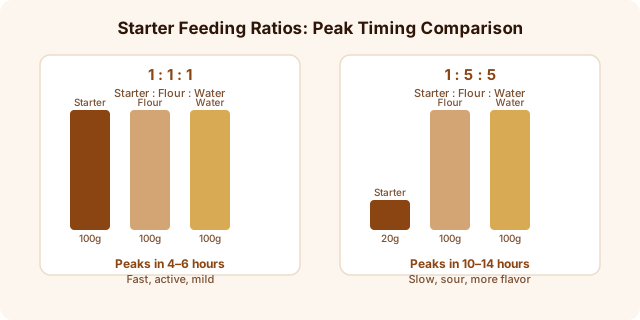
Feeding ratios are written as starter : flour : water by weight. A 1:1:1 ratio means equal weights of all three. A 1:5:5 ratio means one part starter to five parts flour and five parts water. Both keep a starter alive. They produce very different results.
What a Feeding Ratio Actually Does
When you feed your starter, you're diluting the existing microbial population with fresh food (flour) and water. The ratio controls:
- How long until peak activity, more food relative to starter means the microbes take longer to eat through it all; lower ratios (1:1:1) peak in 4–6 hours at room temperature; higher ratios (1:5:5) peak in 10–14 hours
- How sour the starter tastes and smells, more dilution means less acetic acid accumulates; a 1:5:5 starter tastes milder than a 1:1:1 starter fed the same flour
- How long the starter holds at peak, a high-ratio starter has more food reserves; it stays active longer before collapsing
This matters because you want to use your starter at peak, that moment when it's doubled (or more) and the surface is domed or just starting to fall. Using it before peak gives weak leavening. Using it after peak gives a sour, deflated starter that may not have enough active yeast to raise your dough well.
1:1:1, The Daily Maintenance Ratio
Mix 20g starter + 20g flour + 20g water. That's a 1:1:1 feed.
This ratio is used to keep a starter alive and active when you're baking regularly, every day or every other day at room temperature. At 24°C (75°F), a 1:1:1 starter will typically peak in 4–6 hours, fall within 8–10 hours, and need feeding again within 12–24 hours.
When to use it:
- Baking once or twice a week with room-temperature storage
- Building up starter for a bake that same day
- Recovering a starter that's been in the fridge and needs a fast refresh
The math: 20g starter + 20g flour + 20g water = 60g total. If your recipe calls for 100g starter, build the full amount in one feed: 33g starter + 33g flour + 33g water = ~99g (rounding). Check your recipe quantities with the sourdough calculator, it shows you exactly how much starter you need based on your dough weight and starter percentage.
One practical note: With a 1:1:1 ratio in a warm kitchen (26°C+), your starter can peak in 3–4 hours. That's a tight window. If you miss it and it collapses, you'll get weak leavening in your dough. In summer, either use a 1:2:2 or 1:3:3 ratio to slow things down, or keep a cooler in the kitchen.
1:2:2 and 1:3:3, The Everyday Sweet Spot
Most home bakers who bake 2–4 times per week settle here.
- 1:2:2: 20g starter + 40g flour + 40g water. Peaks in 6–8 hours at 24°C. Good for morning feeds if you're planning to bake in the evening.
- 1:3:3: 20g starter + 60g flour + 60g water. Peaks in 8–10 hours at 24°C. Good for overnight feeds if your kitchen is warm.
These ratios give you a more forgiving peak window. The starter holds at peak for 1–2 hours before dropping, rather than 30–45 minutes with 1:1:1.
Worked example, bake day timing with 1:2:2:
- 7:00 AM: Feed starter (1:2:2, 20g + 40g + 40g)
- 2:00–3:00 PM: Starter at peak (6–8 hours at 24°C)
- 2:30 PM: Mix dough using 100g starter (you have 100g from this feed)
- 2:30–8:00 PM: Bulk fermentation (5–6 hours at 24°C)
- 8:00 PM: Shape, refrigerate overnight
- Next morning: Bake
This is a workable schedule for most people with day jobs.
1:5:5, The Slow Build for Timing Control
Feed 10g starter + 50g flour + 50g water. Total: 110g. Peaks in 10–14 hours at room temperature.
This ratio is used when you need peak to align with a specific time that's far out. If you're going to bed at 10 PM and want your starter to peak at 8 AM, a 1:5:5 fed in a kitchen that stays around 20°C overnight works well.
It also produces a milder-tasting starter. Bakers who prefer less sour bread often build their levain (the portion of starter used in the dough) at 1:5:5 or 1:10:10 to keep acidity lower.
When to use it:
- Cold kitchens (18–21°C overnight)
- Overnight builds to hit an early morning bake
- Levain builds where you want mild flavor
- Weekly bakers who keep the starter in the fridge all week and do one big build the night before
Fridge Storage and the Weekly Feeder
If you bake once a week or less, refrigerator storage makes more sense than daily feeding. At 4°C, microbial activity slows dramatically. You can go 5–7 days between feeds.
Fridge feeding protocol:
- Pull starter from fridge. Let it warm 30–60 minutes.
- Feed 1:5:5 at room temperature.
- Leave at room temperature 2–4 hours until you see some bubbling.
- Return to fridge. The cold slows fermentation without stopping it.
Before baking, pull the starter 12–24 hours ahead and do one or two room-temperature feeds (1:1:1 or 1:2:2) to get activity back up. A cold, under-fed starter will under-leaven your dough.
How to tell if your fridge starter needs feeding: If there's a layer of liquid (hooch) on top and it smells sharply of alcohol or acetone, it's overdue. Pour off the hooch, discard all but 20g, and feed 1:5:5. Give it a full room-temperature feed cycle before using.
The Float Test, Useful, Not Definitive
Drop a small spoonful of fed starter in water. If it floats, it has enough gas to leaven bread. If it sinks, it may not.
This test works most of the time. But a fully active starter can sink if the bubbles are small and distributed (rather than large). And a floating starter that peaked 4 hours ago and is collapsing will float but leaven weakly.
The better test: watch the volume. When your starter has doubled and the surface is domed with visible bubbles, it's ready. A ruler taped to the jar or a rubber band marking the start level removes all guesswork.
Flour in Your Starter: White vs Whole Wheat
Most bakers maintain their starter on white bread flour or all-purpose. Both work. Whole wheat feeds an even more active starter because the bran carries more wild yeast and bacteria.
Feeding your starter 10–20% whole wheat in the maintenance flour is a common technique for bakers who find their starter sluggish. The extra microbes speed up peak time and boost activity noticeably.
Just be consistent. Switching your starter from white to whole wheat mid-cycle can cause erratic behavior for 2–3 feed cycles as the bacterial balance shifts.
Water Temperature and Ratio
Water temperature matters more than most bakers realize. Warm water (28–30°C) accelerates fermentation; cold water (15–18°C) slows it.
This is another lever you can pull to control peak timing without changing your ratio. In winter, use water at 28°C for a 1:3:3 feed to hit the same peak time you'd get in summer with room-temperature water.
For your dough mixing water, the same principle applies. Use the calculate your dough to work out your ingredients, then factor in desired dough temperature when you mix.
Building Your Feeding Schedule
Don't try to memorize ratios in the abstract. Pick one schedule and bake it 3–4 times to see how your starter behaves in your kitchen, with your flour, at your ambient temperature. Then adjust.
Most bakers who bake consistently have a 2-step process: maintenance feeding at whatever ratio keeps the starter happy through the week, then a same-day levain build timed to peak when their dough mixes.
Read the sourdough baking schedule post for a complete day-by-day timeline that shows how starter feeding fits into the full bake process. And if you're wondering how the 20% starter figure in most recipes gets calculated, the baker's percentage explained post breaks down the full math.
Learn your starter's behavior at one ratio before experimenting with others. Consistency beats optimization every time.