Best Flour for Sourdough Bread: Bread Flour vs All-Purpose vs Whole Wheat
Quick Answer
Best flour for sourdough depends on your goal. Bread flour (12–14% protein) builds stronger gluten than all-purpose (10–12%). Here's the full comparison.
Flour is the foundation of every loaf. The protein content, extraction rate, and grain type determine how much water your dough can hold, how strong the gluten network becomes, and what the final crumb looks like. Choosing the wrong flour for your hydration or technique is one of the most common reasons sourdough underperforms.
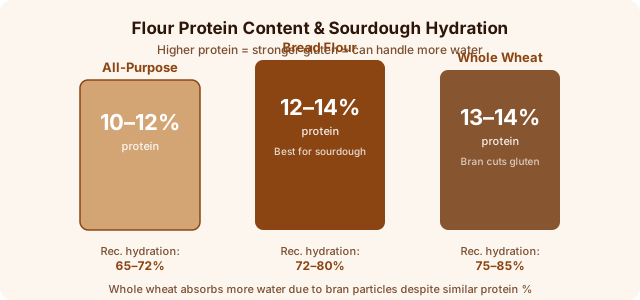
Here's a direct comparison of the most common options, what the protein numbers mean in practice, and when to use each.
Protein Content: The Number That Matters Most
Gluten, the elastic network that traps gas and gives bread structure, forms when two proteins in wheat flour (glutenin and gliadin) hydrate and bind together. The more protein, the more potential gluten. The more gluten, the stronger the dough structure and the more water it can hold.
Why protein content affects hydration: Higher-protein flour absorbs more water because there's more protein to hydrate. A 13% protein bread flour at 75% hydration produces a firmer, more manageable dough than an 11% protein all-purpose flour at the same hydration. Same number, different handling experience.
This is why most sourdough recipes are written around bread flour, and why you need to adjust hydration downward when substituting lower-protein flour.
All-Purpose Flour: 10–12% Protein
All-purpose is the middle-ground flour. It works for sourdough, but it's not ideal for high-hydration baking.
What it produces: Softer, slightly more tender crumb. Less chewy crust. Acceptable gluten development with good technique.
Hydration range: 65–72% is the sweet spot. At 75%+, all-purpose flour often produces dough that's too slack and sticky to shape well. The weaker gluten network can't hold the water.
Best for:
- Beginner bakers who are still developing technique (lower hydration = more forgiving dough)
- Recipes that mix all-purpose with whole grain flours
- Softer sandwich loaves where you don't want a super chewy crumb
- When bread flour isn't available or is significantly more expensive
Popular brands and protein content:
- King Arthur All-Purpose: 11.7% protein (one of the highest in the AP category)
- Bob's Red Mill All-Purpose: 10–11%
- Gold Medal All-Purpose: 10.5%
- Store-brand AP: 9.5–11% (varies significantly)
Note that King Arthur's all-purpose has more protein than some brands' "bread flour." Always check the label rather than assuming by category name.
Bread Flour: 12–14% Protein
Bread flour is the most common choice for sourdough for good reason. The higher protein builds strong gluten that can handle longer fermentation, higher hydration, and more aggressive handling without tearing.
What it produces: Chewier crumb, better structure, stronger oven spring, more blistered crust. Handles fermentation better because the gluten network stays strong through the 4–8 hour bulk fermentation.
Hydration range: 70–80% comfortably. With strong bread flour (12.7%+), even 82% is manageable with good technique.
Why bread flour handles higher hydration: More protein means more gluten strands, which create a tighter network that traps water more effectively. The water distributes through the gluten matrix rather than pooling in pockets.
Popular brands:
- King Arthur Bread Flour: 12.7% protein, consistent, widely available, the benchmark
- Bob's Red Mill Artisan Bread Flour: 13.5% protein, slightly stronger, good for higher hydration
- Gold Medal Bread Flour: 12.5%
- Caputo "00" Manitoba (Italian): 13–14%, excellent for high-hydration baking
One caution: Some "bread flour" products at discount grocery stores are closer to 11.5–12% protein. The protein is on the nutrition label, 3g of protein per 30g serving = 10%, 4g per 30g = 13.3%.
Whole Wheat Flour: 13–14% Protein, But Different
Whole wheat has protein content comparable to bread flour. But the bran and germ present in whole wheat flour complicate the picture significantly.
The bran problem: Bran particles act like tiny razor blades, cutting gluten strands during mixing and fermentation. A 100% whole wheat sourdough has notably weaker structure than a 100% bread flour sourdough, even with similar protein content.
What whole wheat produces: Denser crumb, more complex (nutty, earthy) flavor, higher nutritional value (fiber, minerals, vitamins), darker color.
The absorption difference: Whole wheat absorbs significantly more water than white flour. A 75% hydration dough that's 100% whole wheat will feel considerably stiffer than the same hydration with bread flour. Most bakers using high whole wheat ratios (above 50%) increase hydration by 5–10% to compensate.
Recommended approach: Use whole wheat as a percentage blend rather than the only flour, at least until you understand how your specific whole wheat behaves.
| Whole Wheat % | Effect on Dough | Hydration Adjustment |
|---|---|---|
| 10–15% | Slight earthiness, minimal structure impact | +0–2% |
| 20–30% | Noticeable flavor, some structure weakening | +2–5% |
| 40–50% | Denser crumb, requires technique adjustment | +5–8% |
| 75–100% | Dense, heavy loaf, intentionally rustic | +8–12% |
Worked example: Swapping 20% of your bread flour for whole wheat:
- Original: 500g bread flour, 375g water (75% hydration)
- Adjusted: 400g bread flour + 100g whole wheat, 390g water (78% hydration on the adjusted blend)
- The whole wheat absorbs more water; the extra 15g corrects for this
Use the sourdough calculator when adjusting blends, it keeps the math clean and shows you the final gram amounts for each ingredient.
Rye Flour: The Wild Card
Rye is not a wheat flour. It contains different proteins (secalin rather than gluten-forming proteins) and doesn't form gluten the way wheat does. Rye flour also contains pentosan gums that absorb enormous amounts of water, up to twice their weight.
What small percentages do: Even 5–10% rye added to a wheat sourdough noticeably increases fermentation speed (rye carries more wild yeast and bacteria), adds complex, slightly sour flavor, and improves moisture retention in the finished loaf.
Hydration adjustment for rye additions:
- 5% rye: add 5–10g extra water per 500g flour
- 10% rye: add 10–20g extra water
- 20% rye: add 20–35g extra water
100% rye sourdough: A category on its own. Dense, moist, distinctly sour, extremely long shelf life. Traditional German Roggenbrot and Pumpernickel are 100% rye. Requires a different shaping process (baked in a pan, rye dough can't hold a free-form shape) and much longer baking time at lower temperature.
Tipo "00" and "0" Italian Flours
Tipo "00" is a fine-ground Italian wheat flour. The number refers to how finely it's milled, not protein content. "00" protein ranges widely:
- Caputo Pizzeria "00": 12.5%
- Caputo Manitoba Oro "00": 14.5%
- Caputo Nuvola: 12.5%
The fine grinding produces softer, more extensible dough that's easier to stretch. Good for pizza and ciabatta-style breads where you want extensibility over strength. For a standard sourdough boule, standard bread flour performs equally well and costs less.
Stone-Ground and Heritage Flours
Stone-ground flours retain more of the germ and bran than roller-milled flours, even when labeled "white." They absorb water more slowly (the germ oils coat flour particles and slow hydration) and produce more complex flavor.
Heritage grain flours, einkorn, spelt, emmer, Khorasan, have different gluten structures than modern wheat. Spelt and einkorn have weaker, more extensible gluten. They require lower hydration (reduce by 5–10% from your bread flour baseline), faster fermentation, and gentle handling. Over-mixing tears spelt gluten easily.
These flours are worth exploring for flavor complexity. Start by substituting 10–20% and adjust from there.
Practical Recommendations
For your first sourdough: King Arthur Bread Flour. Consistent, widely available, high protein, behaves predictably. Start at 72% hydration.
For open crumb: High-protein bread flour (13%+) or blend 90% bread flour + 10% whole wheat. Push hydration to 76–78%.
For flavor complexity without handling challenge: 80% bread flour + 15% whole wheat + 5% rye. Adjust hydration up by 8–10g from your baseline. This blend produces excellent flavor while keeping the dough workable.
For sandwich bread: 100% all-purpose or 80% bread flour + 20% all-purpose. Lower hydration (68–72%). The softer crumb and thinner crust are appropriate for sliced sandwich bread.
Check the protein content on your flour's nutrition label before deciding on hydration. Run the numbers for your loaf with your exact flour and target hydration before you mix.
Related reading:
- Sourdough Hydration Guide, protein content and hydration adjustments for every flour type
- Baker's Percentage Explained, how to adjust flour blends without recalculating the whole recipe
- Types of Sourdough Bread, which shapes require the strongest gluten and highest protein flour