Types of Sourdough Bread: Boule, Batard, Baguette, and More
Quick Answer
Types of sourdough bread differ in shape, crumb structure, and ideal hydration. Learn what distinguishes a boule from a batard and how shape affects your bake.
Shape isn't cosmetic. The form you give a sourdough loaf determines its crust-to-crumb ratio, how it holds during baking, what hydration it can handle, and how it eats. A boule and a batard made from identical dough produce different bread.
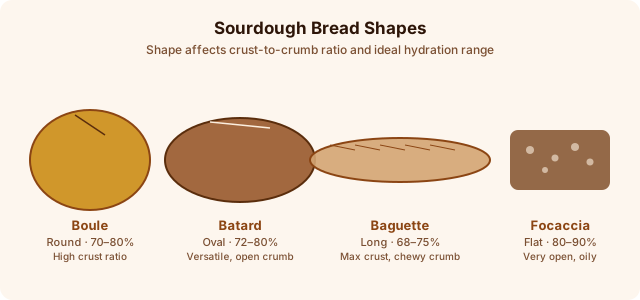
Here's a practical breakdown of the most common sourdough shapes, what they are, how to make them, and which hydration range suits each.
Boule: The Classic Round
A boule (French for "ball") is a round, domed loaf. It's the shape most people picture when they think sourdough.
Crust-to-crumb ratio: Medium. The dome shape gives a thick bottom crust and moderate sidewall crust.
Best hydration range: 70–80%. Below 70% and the boule can look and feel squat. Above 80% and it requires very strong shaping to prevent spreading.
Why the boule works: The round shape distributes oven spring evenly. Steam inside the Dutch oven creates a humid environment that allows maximum expansion before the crust sets. A well-shaped boule with good fermentation can increase 50–75% in volume during baking.
Scoring: A single curved score (ear score) at 15–30° from horizontal is most common. It directs oven spring in one direction and creates a dramatic ear. You can also score a cross or wheat pattern on a boule, these look beautiful but spread more evenly, giving less dramatic rise.
Banneton: Round banneton, 9-inch diameter for a standard 900g loaf. Flour heavily with rice flour (it doesn't absorb and prevents sticking better than wheat flour).
Batard: The Oval Loaf
A batard is an oval or torpedo shape. It fits most standard Dutch ovens better than a large boule and produces a different crumb distribution.
Crust-to-crumb ratio: Higher than a boule. More surface area relative to volume. The ends get extra crust exposure.
Best hydration range: 68–78%. The oval shape is slightly less stable than a round, so very wet doughs can spread more easily.
How a batard differs from a boule: Because the loaf is elongated, oven spring goes primarily upward and slightly outward rather than uniformly. The interior crumb tends to be elongated too, good for slicing because you get similar crumb structure on each slice from crust-to-crust.
Scoring: A single straight score down the center length, or an offset diagonal score. The diagonal gives a more dramatic ear. Score at 15–30° from horizontal.
Practical advantage: A 9×5 batard fits in more Dutch ovens than a large boule. If your Dutch oven is on the smaller side (under 5 qt), a batard may give you more room for oven spring.
Baguette: High Crust, Thin Crumb
A baguette is a long, thin loaf, typically 60–70cm (24–28 inches) and about 5–6cm (2 inches) wide when baked. Crust is the main event. The thin shape maximizes surface-to-interior ratio.
Crust-to-crumb ratio: Very high. Baguette is mostly crust by volume.
Best hydration range: 70–75%. Higher hydration baguettes spread rather than hold the thin shape. Lower hydration makes the crumb too tight for the airy, open interior that defines a good baguette.
Sourdough baguette vs commercial yeast baguette: Commercial baguettes typically use fast-rise commercial yeast. Sourdough baguettes use a levain and cold-proof overnight. The sourdough version has more complex flavor and better staying power, it doesn't stale as fast. The crumb is slightly denser than a commercial baguette but more flavorful.
Equipment: Baguette pans (perforated metal trays with channels) or a baking stone with a steam setup. You can't bake baguettes in a Dutch oven, they don't fit. This is one case where sourdough baking gets more complex from a steam-management standpoint.
Shaping: Baguette shaping is a skill on its own. The dough is divided into ~250g portions, pre-shaped into cylinders, rested 20 minutes, then rolled out to length using a specific tension-building motion. Getting consistent diameter requires practice.
Ciabatta: The Wet, Flat Slipper
Ciabatta (Italian for "slipper") is high-hydration (80–90%), shaped into flat, rectangular loaves with minimal gluten structure compared to a boule. The point is the open, hole-filled interior and thin, crackly crust.
Crust-to-crumb ratio: Low. Ciabatta is mostly interior.
Best hydration range: 80–90%. This is the defining characteristic, ciabatta at 70% isn't ciabatta, it's just a flat loaf.
Why handling is different: At 85% hydration, ciabatta dough is more like a thick batter. It doesn't shape conventionally. The process is:
- Mix flour and water (autolyse 30–60 minutes)
- Add starter and salt
- Multiple sets of coil folds or stretch-and-folds to build gluten
- Bulk ferment
- Turn dough out onto heavily floured surface
- Divide and shape by folding (rather than traditional tension shaping)
- Cold proof in floured couche (cloth) or directly on parchment
No banneton. No traditional scoring. The holes in ciabatta form naturally from the wet dough's gas bubbles expanding during baking.
Baking: On a hot baking stone (preheated 500°F for 1 hour) with a steam tray or cast iron pan of boiling water in the oven. The steam is essential, without it, the crust sets before the loaf expands.
Use the sourdough calculator to calculate your ciabatta formula, at 85–90% hydration, exact gram measurements matter more than at lower hydration where there's more margin.
Focaccia: The Pan Bread
Focaccia is a thick, dimpled flatbread baked in an oiled pan. It's the most beginner-friendly sourdough shape because there's no shaping technique required, you just stretch it into the pan.
Crust-to-crumb ratio: Low-to-medium. Thick, soft interior with a crispy, olive-oil-fried bottom crust.
Best hydration range: 80–90%. Focaccia dough is wet. The pan contains it, so spreading isn't a problem. High hydration produces the open, pillowy crumb that makes focaccia excellent.
Process differences:
- No pre-shaping or final shaping, pour dough into oiled pan and stretch gently
- No cold proof required (though overnight cold proof improves flavor)
- No scoring, the dimpling with your fingers creates the signature texture
- High olive oil content (3–4% of flour weight = 15–20g for a standard loaf) in the dough and generously on top
Toppings: Flaked salt, rosemary, cherry tomatoes, olives, caramelized onions, added after the final dimpling before baking.
Baked at: 450–475°F (232–246°C) in the oven directly (no Dutch oven), 25–30 minutes until golden brown on top and bottom.
Pan Loaves: Sourdough in a Tin
A sourdough pan loaf (baked in a standard 9×5 or 8.5×4.5 loaf pan) is lower-effort than a free-form boule. The pan supports the dough, so shaping technique matters less.
Crust-to-crumb ratio: Low. The pan sides create soft crusts; only the top crust is exposed to full dry oven heat.
Best hydration range: 68–78%. Pan loaves don't need the tension of a free-form shape, but they also don't need to be extremely wet, you want dough that holds enough structure to dome above the pan during baking.
Best for: Sandwich bread, beginner bakers, high whole-grain recipes (which can be harder to shape free-form due to bran cutting gluten strands), or enriched sourdoughs with eggs and butter.
Baking: At 375–400°F (190–204°C), uncovered, 40–50 minutes. The lower temperature (compared to a Dutch oven bake) accounts for the lack of steam management. Some bakers tent with foil after 30 minutes to prevent over-browning on top.
Choosing Shape Based on Your Goal
| Shape | Hydration | Crust/Crumb | Best For | Difficulty |
|---|---|---|---|---|
| Boule | 70–80% | Balanced | Everyday sourdough, slicing | Intermediate |
| Batard | 68–78% | Balanced | Slicing, Dutch oven fit | Intermediate |
| Baguette | 70–75% | Crust-heavy | French-style, sides dishes | Advanced |
| Ciabatta | 80–90% | Crumb-heavy | Sandwiches, open crumb | Advanced |
| Focaccia | 80–90% | Crumb-heavy | Flatbread, toppings | Beginner |
| Pan loaf | 68–78% | Crumb-heavy | Sandwich bread, beginners | Beginner |
Shape and Fermentation
One thing most guides skip: the shape affects how the loaf ferments during the cold proof. A boule has a smaller surface area relative to volume, so it cools more slowly and fermentation doesn't stop as quickly when you put it in the fridge. A thin baguette cools fast and essentially stops fermenting within 30 minutes of refrigeration.
This matters for timing. If you're baking boules and baguettes from the same dough batch, the boules may need a shorter cold proof to avoid overproofing.
Dial in your gram weights for any shape with the calculate your dough tool, then adjust based on the shape-specific considerations above.
Related reading:
- Sourdough Hydration Guide, which hydration ranges each shape handles best
- Common Sourdough Mistakes, includes poor shaping as one of the top 7 mistakes
- Best Flour for Sourdough, flour protein affects which shapes are achievable at high hydration